

ST. MARK’S CHURCH, NIAGARA-ON-THE-LAKE
St. Mark’s is probably the most historic church in the Province of Ontario. The interior is festooned with memorabilia of the early history of the Province. It was used by the British/Canadian forces as a hospital in 1812 and by the Americans as a barracks after their successful invasion of 27 May, 1813.
The very first memorial to greet you on the right as you walk past the front door is the one dedicated to Captain Martin McClellan of the Lincoln Militia who died in defence of Niagara on 27 May, 1813. Check it out during your next visit to the Shaw Festival!
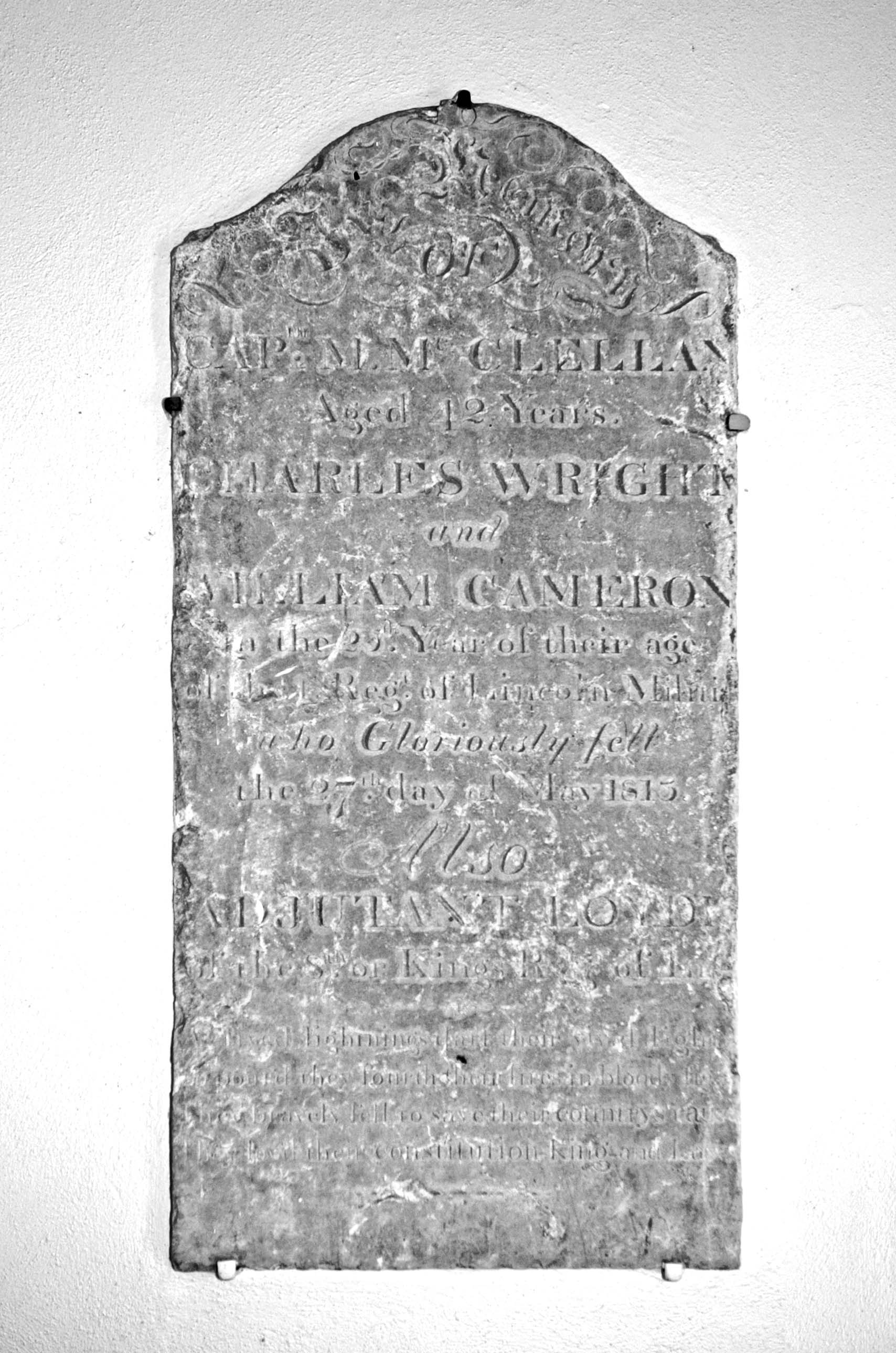
MEMORIAL TO CAPTAIN MARTIN McCLELLAN
“As lurid lightnings dart their vivid light, So poured they forth their fires in bloody fight. They bravely fell and saved their country’s cause. They loved their constitution, King and laws”.
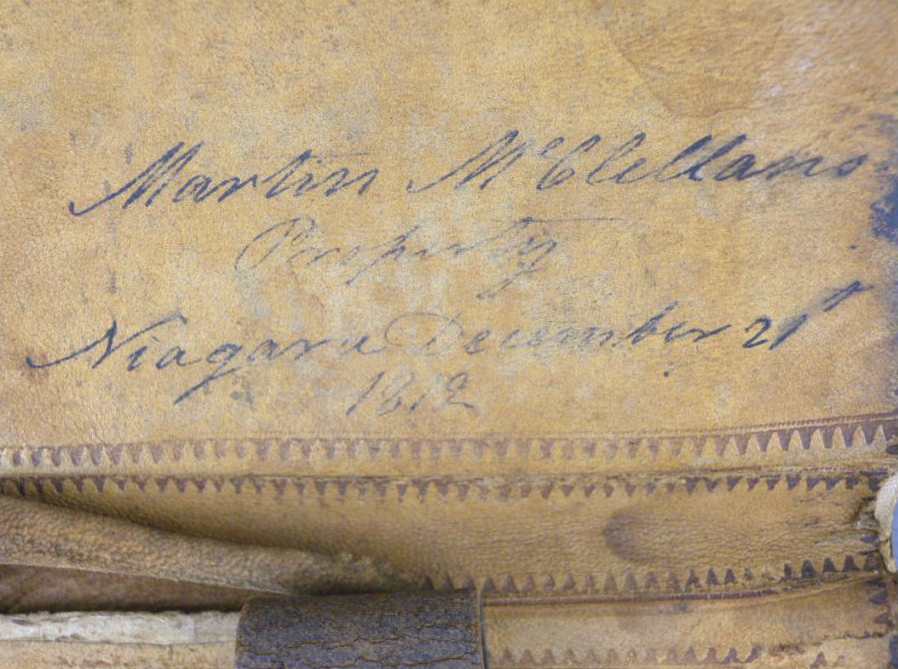
It was May 26th, 1813; the wife of Captain Martin McClellan of the 1st Lincoln Militia left the family farm on John Street in the Town of Niagara to seek refuge in nearby Virgil, Ontario. Martin McClellan visited her in Virgil and provided his wife with his watch and his wallet. He told his wife that he would never see her or their children again.
For 5 days, McClellan could see what the rest of the British garrison in Niagara could see. Across the Niagara River, thousands of American troops on parade around Fort Niagara, workers preparing batteries and boats and 17 armed vessels returning triumphantly from the burning of York. McClellan and the small garrison in Niagara would be no match.
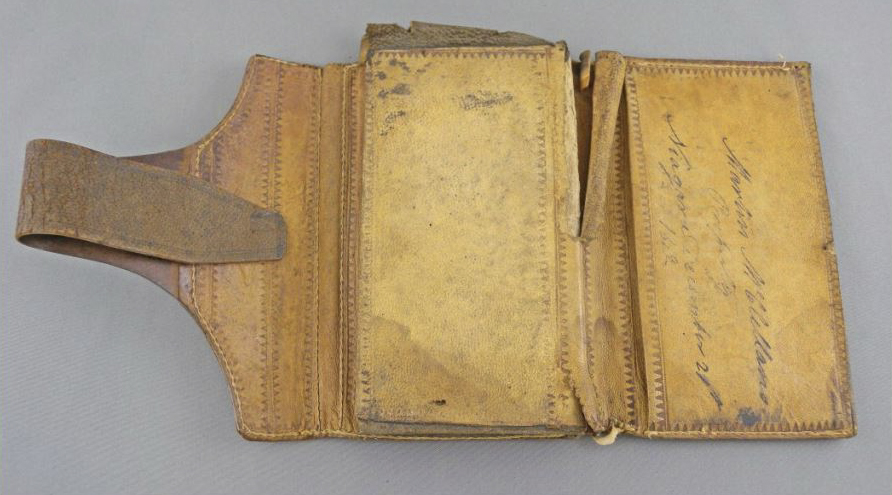
MARTIN McCLELLAN’S WALLET
(Images courtesy of the Niagara Historical Society & Museum www.niagarahistorical.museum)
As fog lifted at daybreak the following day, McClellan would see 16 ships, 134 boats and scows (each with 30 – 50 American soldiers) two miles from the Town of Niagara. By 9 o’clock, some 2,300 American soldiers started the land assault under the cover of heavy artillery. The British defense was approximately 567 men, both regulars and militia. It took several attempts for the Americans to assemble on a plain at the western end of the town.
McClellan was in line with the rest of his company facing the U.S. forces a mere 5 – 10 metres away. The two sides fought for over 15 minutes. In the end, the British were forced to retreat, leaving 300 dead or wounded soldiers lying in the field. Martin McClellan was one of them. He died in defence of his country, his home and his family.
Captain McClellan had apparently died in vain. The war on the Niagara was now completely lost with the Americans in complete control of Fort George and Fort Erie. Despite their plucky resistance over the past 18 months of the war, the residents of Niagara would now have to resign themselves to a foreign occupation and eventual political annexation – a very bitter pill for the stalwart Loyalists to swallow.
The war was now effectively over. The Americans had won. Or so it was thought!!

JAMES MARTIN BURTON McCLELLAN
A century later, Captain Martin McClellan’s grandson would serve in World War I where he received a severe GSW injury in France which shattered his thigh bone and left him with a permanent limp.

JAMES MARTIN BURTON McCLELLAN AND ME
Above is a legacy photo from many years ago of my uncle “Burt” McClellan or “JMB” as he liked to call himself. It was he who donated the wallet, a priceless family heirloom, to the Niagara Historical Society & Museum.
In this present overlap period where we celebrate both the bi-centennial of the War of 1812 and the start of the commemoration of the Great War, I take this opportunity to salute the spirit of the fighting McClellans!!